

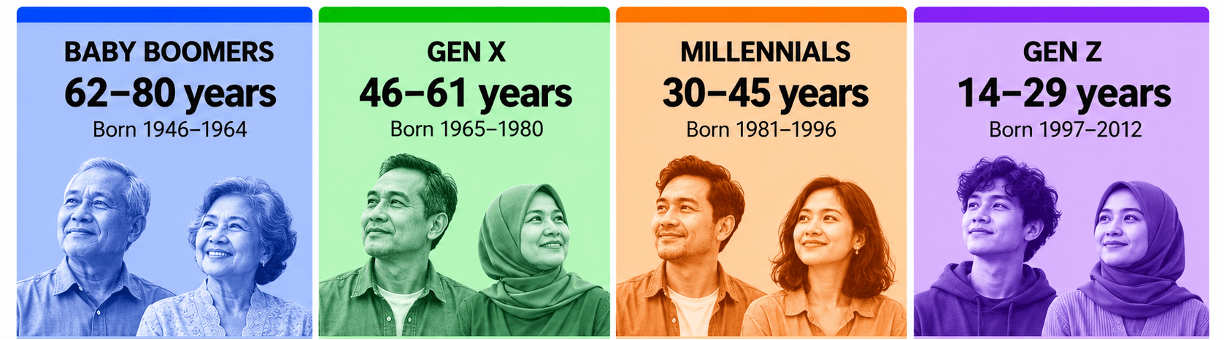
Many Indonesian Baby Boomers and Gen X grew up under restrictions on public criticism of the government. Millennials experienced the transition after Reformasi, while Gen Z Indonesia grew up as social media expanded opportunities to express opinions. Today, concerns about work and living costs can readily become public discussions about government priorities. Kawula17’s research gives those discussions a concrete focus: young people want jobs prioritised, and many are dissatisfied with delivery.
From private opinions to public conversations
Under Soeharto’s New Order, expressing criticism publicly carried risks. Human Rights Watch documents the censorship, intimidation, and restrictions that constrained political debate. Many Boomers and Gen X Indonesians experienced these conditions. Having an opinion did not necessarily mean feeling able to share it openly.
Millennials grew up across the transition into post-Reformasi Indonesia and the expansion of internet access. Gen Z’s formative years came largely after that transition, as smartphones and social platforms became increasingly accessible.
Today, someone can link an unsuccessful job search to the current economy, share a complaint about food prices, or comment on a government announcement. Others can recognise the experience and add their own. Personal concerns have become part of a wider political conversation.
This does not mean that younger generations care more about politics, but it does help explain why their opinions are often easier to encounter. For anyone interested in Gen Z Indonesia, the concerns behind those opinions also deserve attention.
Gen Z Indonesia: Jobs are a clear priority
In the National Kawula17 Survey Q2 2026, 60% of young Indonesians selected the economy as an important topic, followed by addressing poverty at 41%. Issues requiring government attention included rupiah depreciation (45%), rising fuel prices (41%) and food prices (33%).
Further more, 46% selected the government’s pledge to create 19 million jobs as a top government priority. By comparison, just 3% selected Makan Bergizi Gratis (MBG).
These concerns bring government policy close to everyday life. Finding work and covering regular expenses affect the choices people can make, from supporting family members to planning for their own future.
Employment promisses from the government are now a tangible. Gen Z can assess it against the opportunities they encounter and the experiences of those around them.
Delivery is where expectations meet experience
Alongside the demand to prioritise jobs, 60% are dissatisfied with delivery of the jobs pledge by the government. Taken together, the findings identify employment as an area where young people expect greater attention and more progress.
Many Gne X-ers grew up having to be careful about criticising the government openly. Now, young Indonesians, particularly Gen Z, are making their expectations clear: prioritise jobs and address the economic problems they face.
Survey reference: Kawula17, National Kawula17 Survey Q2 2026, pp. 22, 24, 35 and 58. Online fieldwork conducted 19–21 June 2026 among 409 respondents aged 17–35. This survey was conducted via Surveyou! by BOI Research.